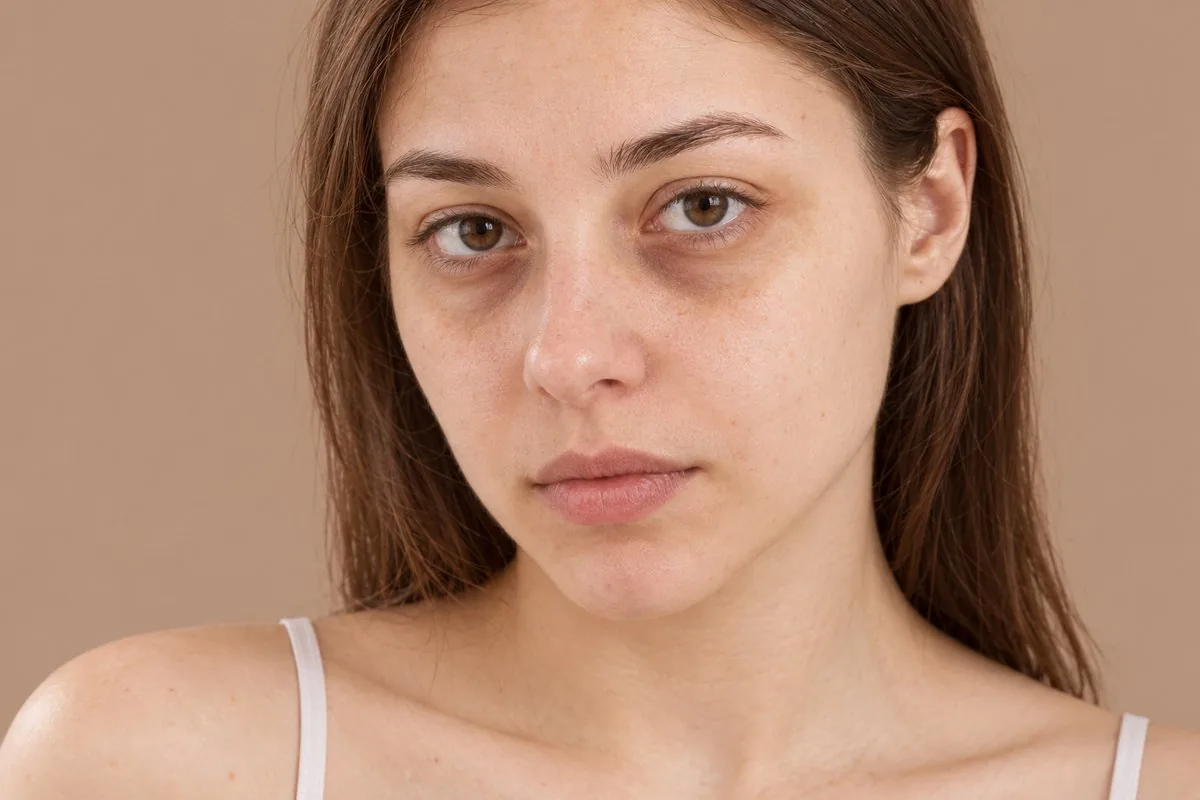
If you have searched for dark eye circle treatment malaysia, you have probably found clinic directories and eye-cream lists. Few explain why your circles look the way they do, which matters: a laser that fades brown pigment does little for a blue vein or a hollow.
We are BeauLife Clinic, an MOH-registered aesthetic clinic (KKLIU 1970/2019) with LCP-certified doctors, running since 2017 at five Klang Valley branches. This guide covers the four types of dark circles, how common each is in Asian skin, a home self-check, and what each dark eye circle treatment Malaysia clinics offer typically costs.
Is your under-eye skin thin, with a bluish or tired look?
Jalupro Young Eye is an under-eye injectable with hyaluronic acid and amino acids that helps thicken thin skin over a few weeks.
See how Jalupro Young Eye works for thin under-eye skinFirst, a US dermatologist runs through the common reasons dark circles appear.
8 reasons why you have dark circles, from a dermatologist
1. What causes dark circles under the eyes?
Quick Answer: Dark circles have four main causes: extra brown pigment in the skin, blood vessels showing through thin skin, darkening after rubbing or eczema, and a hollow that casts a shadow. A 2016 review found most people have more than one. The cause decides which treatment can help, so naming it comes first.
The under-eye skin is among the thinnest on the body, so anything under it shows through. A 2016 review of dark-circle research links the colour to bone shape, soft tissue and the skin itself. In practice, doctors group dark circles into four types:
- Pigment type (brown). Extra melanin, often inherited; doctors call it “constitutional”. It stays the same when you stretch the skin.
- Vascular type (blue, purple or pink). Small vessels showing through thin skin, often worse when you are tired or have a blocked nose.
- Post-inflammatory type. Darkening left behind by eczema, allergy or frequent eye rubbing.
- Shadow type. A groove between the lower lid and cheek that catches shadow, so the skin looks dark even when its colour is normal.
Our Jalupro Young Eye treatment page explains why thin skin is behind so many blue-toned and tired-looking circles.
2. Which type of dark circles is most common in Asian skin?
Quick Answer: In a Singapore study of 200 patients, the vascular type was most common (41.8%), followed by the pigment type (38.6%). The vascular type was seen mostly in Chinese patients, and the pigment type mostly in Malay and Indian patients. A Malaysian Chinese study found a mixed pigment and vessel type most often.
| Study and type | Share of patients (bar, scale 0 to 60%) | Who it was seen in most |
|---|---|---|
| Singapore, 200 patients with dark circles (Ranu 2011) | ||
| Vascular (blue, purple) | 41.8% | Mostly Chinese patients |
| Pigment (constitutional) | 38.6% | Mostly Malay and Indian patients |
| Post-inflammatory | 12% | Not split by ethnicity in the abstract |
| Shadow effect | 11.4% | Not split by ethnicity in the abstract |
| Malaysia, 84 Malaysian Chinese adults (Amini 2019) | ||
| Mixed pigment and vascular | Most common type; percentage not given in the abstract | Average age 22; both eyes in 62 of 84 |
| India, 200 patients (Sheth 2014) | ||
| Pigment (constitutional) | 51.5% | Most common form |
| Post-inflammatory | 22.5% | Second most common |
Source: peer-reviewed studies linked in each group, compiled by BeauLife Clinic, November 2026. Some patients had more than one type, so Singapore shares add up to more than 100%. Clinic samples, not the general population. Licence.
What this means for Klang Valley patients:
- Your background shapes the likely type. Blue-toned circles are common in Chinese skin; brown, inherited circles in Malay and Indian skin.
- Mixed types are normal. The young Malaysian Chinese group in the UCSI study most often had pigment and vessels together.
- Shadows are less common than people think. About one in nine Singapore patients had a shadow type, so filler is rarely the first answer.
For a mixed type, the doctor may treat thin skin first with Rejuran i for the eye area, then reassess the pigment.
3. What daily habits make dark circles worse?
Quick Answer: In an Indian study of 200 people with dark circles, 71% reported stress, 63% a family history, 40% too little sleep, 33% eye rubbing and 33% allergies or eczema. These are links, not proof of cause, but rubbing, allergy and lost sleep are the ones you can change.
| Factor | Share of patients (bar, scale 0 to 100%) | Can you change it? |
|---|---|---|
| Linked conditions | ||
| Stress | 71% | Partly |
| Family history of dark circles | 63% | No |
| Atopy (allergy, eczema, hay fever) | 33% | Can be controlled |
| Daily habits | ||
| Lack of adequate sleep | 40% | Yes |
| Frequent cosmetic use | 36.5% | Yes |
| Frequent eye rubbing | 32.5% | Yes |
| Short-sightedness not corrected | 12% | Yes, with glasses |
Source: Sheth, Shah and Dave, Indian Journal of Dermatology, 2014 (200 patients). Associations in one clinic sample; they do not prove cause. Licence.
Two of these explain why results fade for some people:
- Rubbing keeps darkening the skin. Itchy eyes from dust mite allergy lead to rubbing, which leaves pigment. Control the itch first.
- Family history means maintenance. Inherited pigment lightens but returns without sun care.
Our guide on what you can do for dark circles under your eyes covers the home steps, from sleep to sunscreen.
4. How can you tell which type of dark circles you have?
Quick Answer: Use daylight, a gentle stretch and a change in head angle. Brown that stays when stretched is pigment. Blue-purple that deepens when stretched is vascular. Darkness that fades when light falls straight on it is a shadow. A doctor confirms the type, often finding two together.
The 2014 Indian study sorted patients with an eyelid stretch test and a special lamp. A simpler home version takes five minutes:
- Stand by a window in daylight. With no make-up, note the colour: brown, blue-purple, or a dark line under the lid.
- Gently stretch the skin. Pull the lower lid skin sideways with a fingertip. Brown that stays the same is pigment. Colour that turns more blue or purple points to vessels under thin skin.
- Tilt your head up towards the light. If the darkness fades when light falls straight on it, a hollow is casting a shadow.
- Check for a pouch and take photos. A soft bulge that stays all day is fat, not a dark circle. Bring daylight photos to your doctor assessment.
If you also see fine, crinkled lines, our guide to non-surgical treatments for under-eye wrinkles explains how lines are treated alongside dark circles.
Dark circles that look darker in some lights than others?
That is often a shallow hollow. Deusaderm is a collagen gel used under the eyes to soften shadows and thin skin.
Read how Deusaderm collagen softens under-eye shadows5. Which dark eye circle treatment in Malaysia suits each type?
Quick Answer: Each dark eye circle treatment Malaysia clinics use targets one type. Pigment-type circles may suit PICO laser, chosen by the doctor. Vascular circles from thin skin suit boosters such as Jalupro Young Eye, Rejuran i, Restylane Vital Light or Deusaderm. Shadow circles suit Deusaderm or a soft tear-trough filler. Rubbed, inflamed skin needs the allergy treated first.
| Treatment | Pigment (brown) | Vascular / thin skin | Post-inflammatory | Shadow (hollow) | Sessions; downtime |
|---|---|---|---|---|---|
| Laser (nothing injected) | |||||
| PICO laser | Main use | Not the right tool | Can help, once the cause is controlled | Not the right tool | Several, weeks apart; mild redness |
| Skin boosters | |||||
| Jalupro Young Eye | Not the right tool | Main use | Not the right tool | Mild shadow only | 1 to 2; small bumps for a day |
| Rejuran i (eye version) | Not the right tool | Main use | Can help with skin repair | Not the right tool | 3; small bumps for a day |
| Restylane Vital Light | Not the right tool | Can help | Not the right tool | Not the right tool | 3; small bumps for a day |
| Collagen and filler | |||||
| Sunmax Deusaderm | Not the right tool | Main use | Not the right tool | Shallow hollow | 1 to 2 syringes; minimal |
| Restylane (tear-trough filler) | Not the right tool | Not the right tool | Not the right tool | Main use | 1; mild swelling 1 to 2 days |
Source: BeauLife Clinic dark eye circles concern page and treatment pages, November 2026. A general guide; your doctor confirms what fits your skin. Licence.
Reading the table:
- Boosters cover the most common type. Four of the six options target thin skin, which is what lets vessels show.
- Laser is for brown, not blue. A vessel under thin skin does not fade with a pigment laser.
- Filler is for a groove only. Our Restylane dermal filler page explains how a soft gel supports a tear trough when there is a real hollow.
6. Do dark circle treatments actually work?
Quick Answer: Partly, and mostly in small studies. A pigment laser worked over three sessions in a 2018 study but not after one. Jalupro Young Eye made lower-lid skin about 53% thicker in 40 women, and a polynucleotide booster improved dark circles in 61 people. None had a placebo group.
Here is what each study actually measured:
- Picosecond laser. In two US trials, three sessions of a 755 nm picosecond laser lightened dark circles in 10 adults, still visible at day 132; one session at 1064/532 nm in 19 adults made no significant change. Our Discovery PICO uses 1064 and 532 nm, so the doctor sets the plan.
- Jalupro Young Eye. In a 2026 study of 40 women, lower-lid skin went from 1.34 to 2.05 mm thick on ultrasound and 85% were satisfied at three months.
- Polynucleotide booster. A 2026 study of 61 adults found less severe dark circles after three sessions, most clearly in the hollow type. It tested a different PN brand from Rejuran; some authors declared fees from makers.
- Tear-trough filler. A review of 23 studies found high satisfaction lasting 8 to 12 months, with a blue-grey tint as a possible side effect.
In short, these options lighten dark circles, rarely remove them, and work most reliably on the type they were designed for. Our PICO laser page shows how pigment plans are usually spaced.
Thin, tired-looking skin under the eyes?
Restylane Vital Light places tiny droplets of soft hyaluronic acid in the skin for hydration and a smoother, brighter finish.
Explore Restylane Vital Light skin booster7. How much does dark eye circle treatment in Malaysia cost?
Quick Answer: In the Klang Valley, PICO laser typically costs RM 600 to 2,000+ per session, Rejuran RM 1,200 to 2,500 per session, Restylane Vital Light RM 1,100 to 1,800 per syringe, Deusaderm RM 3,500 to 4,000 per syringe and Restylane filler RM 1,200 to 3,500 per syringe. Jalupro Young Eye is quoted after assessment.
| Type and treatment | How it adds up | Results seen | First course (bar, scale RM 0 to 9,000) |
|---|---|---|---|
| Pigment type | |||
| PICO laser | About 3 sessions at RM 600–2,000+ | Gradually, over sessions | RM 1,800–6,000+ |
| Vascular / thin-skin type | |||
| Jalupro Young Eye | 1 to 2 sessions | 7 to 10 days, builds over weeks | Quoted after assessment |
| Restylane Vital Light | 3 sessions, if one syringe each, at RM 1,100–1,800 | 2 to 4 weeks | RM 3,300–5,400 |
| Rejuran i | 3 sessions at RM 1,200–2,500 (eye version may be quoted differently) | 3 to 4 weeks | RM 3,600–7,500 |
| Shadow type | |||
| Restylane tear-trough filler | Usually 1 syringe at RM 1,200–3,500 | On the day; settles in 2 weeks | RM 1,200–3,500 |
| Sunmax Deusaderm | 1 to 2 syringes at RM 3,500–4,000 | On the day | RM 3,500–8,000 |
Illustrative scenario by BeauLife Clinic, November 2026: session counts multiplied by the typical Klang Valley ranges on our treatment pages. Not a price list; your exact quote follows a consultation. Licence.
When you compare quotes for dark eye circle treatment malaysia clinics give, ask three things:
- Per session or per course? Lasers and boosters are usually a course; filler one visit.
- How many syringes? Under-eye doses are small, but a quote should say how much product is planned.
- What about maintenance? Boosters are commonly repeated about every six months; filler and collagen last longer.
8. When are dark circles a medical problem, and what are the risks?
Quick Answer: See a GP before any dark eye circle treatment Malaysia clinics offer if dark circles appear suddenly, affect one eye only, come with swelling, itching or rash, or come with tiredness and breathlessness. Clinic treatments are usually mild, with bumps or bruising for a few days, but under-eye filler needs an experienced doctor because of nearby blood vessels.
Check these with a GP or eye doctor before any aesthetic treatment:
- One-sided darkness or swelling. Not typical of ordinary dark circles.
- Itchy, flaky lids. Eczema or allergy needs treating, or the darkening returns.
- Pale skin with constant tiredness. Anaemia is a listed contributor in recent dark-circle research; a blood test is simple.
Treatment risks to know:
- Boosters and collagen. Small bumps, swelling and bruising that usually settle within days.
- Filler. The US FDA warns that filler in a blood vessel can rarely harm skin or vision, so under-eye filler is doctor-only.
- Laser. Darker skin can darken temporarily, so settings matter.
Whoever treats you, check they are a registered doctor on the MeRITS medical register. Our guide to choosing a safe aesthetic clinic in Malaysia covers the other checks. If the whole midface has dropped, not just the under-eye, see our guide to face lifting treatment in Malaysia.
9. The short version
The right dark eye circle treatment malaysia patients can choose depends on the type: laser for brown pigment, boosters for blue circles and thin skin, collagen or filler for shadows, and allergy control for rubbed skin. Most Asian dark circles are vascular or pigment types, often mixed, so plan in stages. The BeauLife Clinic homepage lists every treatment at our five branches, and you can read about how our doctors work.
10. Frequently Asked Questions
1. Which dark eye circle treatment in Malaysia suits me?
It depends on the type. Brown pigment may respond to PICO laser, blue circles from thin skin respond to boosters such as Jalupro Young Eye or Rejuran i, and a shadow from a hollow suits Deusaderm or a soft filler. Many people have two types, so a doctor checks first.
2. How much does dark circle treatment cost in the Klang Valley?
PICO laser typically costs RM 600 to 2,000+ per session, Rejuran RM 1,200 to 2,500 per session, Restylane Vital Light RM 1,100 to 1,800 per syringe and Deusaderm RM 3,500 to 4,000 per syringe. Jalupro Young Eye is quoted after assessment.
3. Can dark circles be removed completely?
Usually not. Treatments make dark circles lighter, but inherited pigment and thin skin tend to return, so most people plan maintenance and daily sun care.
4. Do eye creams work for dark circles?
Brightening creams and sunscreen can help mild brown pigment over months. They do little for blue circles from thin skin or shadows from a hollow.
Not sure which type of dark circles you have?
WhatsApp us on +6016-251 7687. A BeauLife doctor will check your under-eyes in good light, explain the type and which treatment fits, and give you the full price before anything starts. We open 10am–7pm on weekdays, 10am–5pm on weekends.
Book a dark circle consultation